
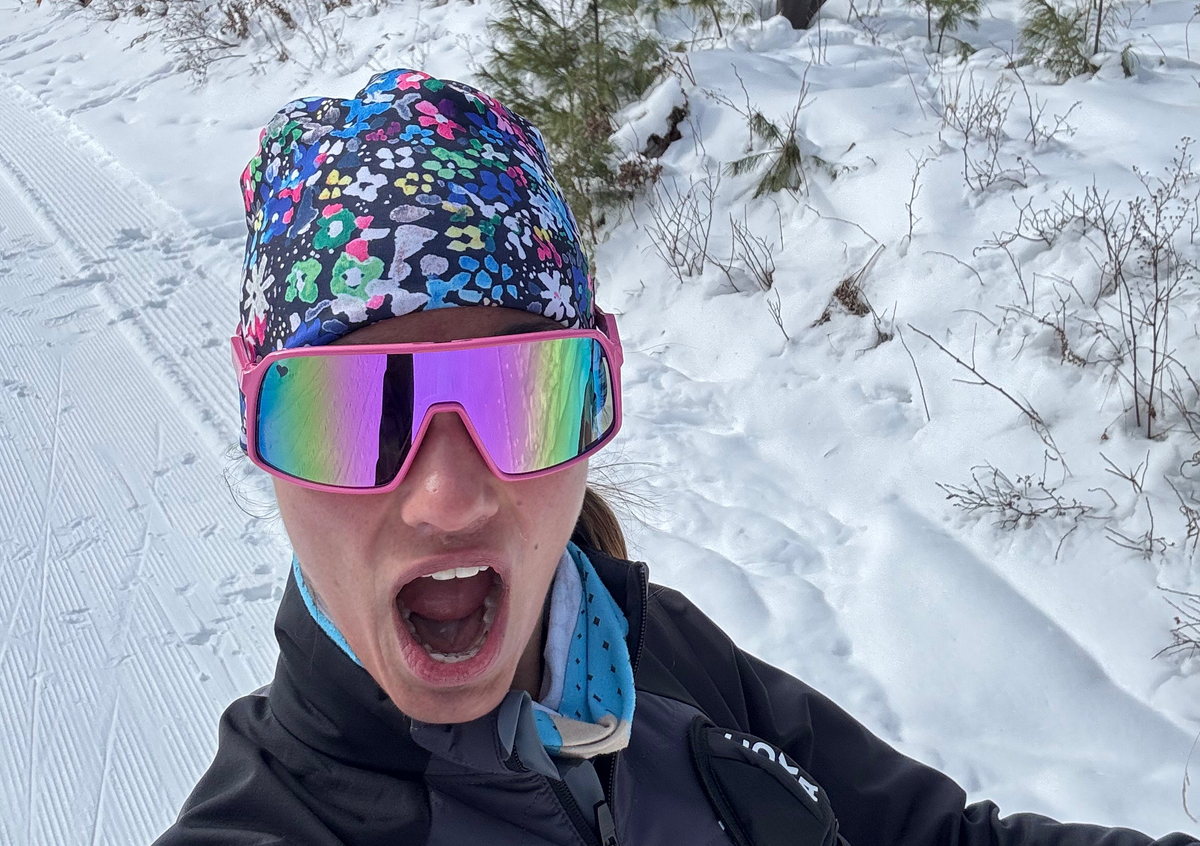
Nikolett Demeter: Born for the Mountains
AMBASSADÖRK Nikolett grew up swimming in Hungary, found triathlon in Panama, and moved to Tahoe only to discover that three years onto skinny skis she is still, in her own words, gasping. This one is about what the learning curve does for your head.
With that, let's get to it.
ambassadörks: Born for the Mountains
I was born for the mountains, just not in the place you would expect. In a small country like Hungary, where our mountains only reach about 2,000 to 3,000 feet, skiing is not the first sport that comes to mind. Like many of my fellow countrymen and women, I started in the water, first swimming and then water polo. That is where my love for sport began, and I am deeply grateful to my parents for sending me down that path.
Then life took me abroad. Almost five years in Mexico and ten in Panama grew my love for the outdoors, and that is where I discovered triathlon, trail running and open water swimming. Moving to Northern California changed everything again.
Almost three years ago, I stepped onto skinny skis for the first time. As a lifelong endurance athlete, I thought, this will be easy for me. It was not. Ten minutes in, I was gasping for air, trying to coordinate legs and arms that refused to work together. Oh gosh, it was challenging. It still is.
And yet something shifted right there. Instead of quitting, I felt a new challenge: I wanted to prove to myself that I could learn this. That moment taught me more about mindset than years of comfortable training ever had.
Being a beginner again is one of the best things you can do for your mind.
What nature does for the mind
Time outdoors lowers the volume of the mind. Away from screens and constant notifications, attention gets a chance to rest, and many people notice their stress easing within minutes. Studies of nature exposure, including one often cited finding of about two hours a week, link it with better reported wellbeing. That is approximate, and it does not need to be a single long outing.
Movement adds a second layer. Exercise helps regulate stress hormones and supports mood and sleep. Put movement and nature together and you get something neither gives alone: a body that is working and a mind that is not racing.
It also changes the question. Indoors, we ask “how do I look?” or “how fast am I?” Outside, the question becomes “what can I notice?” The light on the snow, the sound of my own breathing, the cold on my cheeks, the beauty of the blue sky, a smile from a stranger, birds chirping. Oh, so many things, not enough space to write down all of it.
Being a beginner again is one of the best things you can do for your mind.
Willpower is a skill, not a mood
Most people think willpower is something you either have or you don't. I see it differently: willpower is a habit you build, and it is built in small, repeatable acts.
On a long training day, nobody feels motivated at every mile. What gets you through is a decision you made earlier, a plan so simple that you do not need to negotiate with yourself. Shoes by the door. Skis in the car. A route chosen the night before. A friend waiting at the trailhead.
Every time you keep a small promise to yourself, you teach your brain something: I am someone who shows up. That identity, more than any single workout, is what carries you through winter, stress, and setbacks.
And on the days you cannot show up fully, a ten-minute walk still counts. Consistency beats intensity.
The quiet you find on skinny skis
I fell in love with cross-country skiing, completely. It has become the best cross training for trail running I could have wished for, but it gave me far more than fitness.
The community is wonderful. You do not wait in line for hours to reach the top of a mountain, and the trails are never crowded. You find peace. Sometimes it is just you and a squirrel running across the trail with a pine cone in its mouth. If you are luckier, you might spot a bobcat or a coyote.
That quiet is where the emotional work happens. Out there, my thoughts slow down, my breathing finds its rhythm, and the stress of the day has somewhere to go. And because skiing is still a challenge for me, it keeps reminding me that growth feels uncomfortable before it feels good.
Closing thought
You do not have to feel ready. You only have to step outside, and let the trail, the snow or the water do part of the work for you.
This winter, I invite you to try it: one small outing, one small promise kept. See what shifts in your mind. And if it is hard to start, that usually means it matters.
See you out there!
Reference: M. P. White et al., “Spending at least 120 minutes a week in nature is associated with good health and wellbeing,” Scientific Reports, June 2019.
Authors Note: I love following a healthy, active lifestyle, and I love sharing it with people and helping them do the same. I'm a lifelong endurance athlete — trail running, triathlon, open-water swimming, and every winter since I moved to Tahoe, Nordic skiing, which has become my favorite cross training during the winter. There is no off-season, let's go! Nikolett can be found over on the grid @nikolett_d12
the closer: What We're Thinking About.
That being a beginner on purpose might be the most underrated training there is. Nikolett has swum, run and raced her way across three continents, and the thing she chose to be humbled by is a pair of skinny skis in Tahoe. Shoes by the door. Skis in the car. One small promise kept. Takk, Nikolett, and see you out there.
Share:
Ryan Guthrie: Are We Ever Truly Ready?