
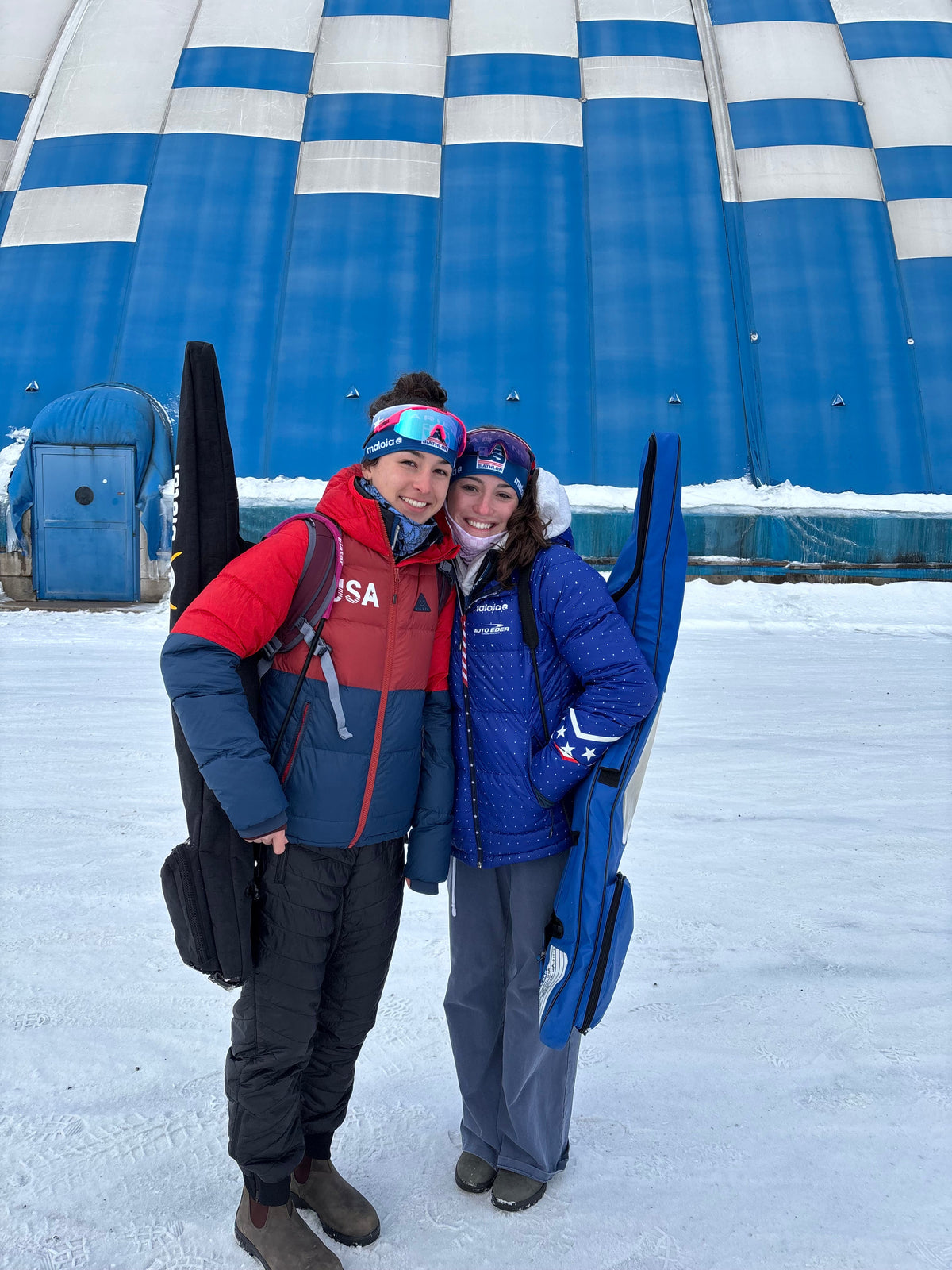
Alex Taylor: Good Pain, Bad Pain
AMBASSADÖRK Alex has raced biathlon in Korea, Estonia and Latvia, and spent the last two years learning the difference between the pain you choose and the pain you don't. This one does not wrap up neatly, and that is exactly why she wrote it.
With that, let's get to it.

ambassadörks: Good Pain, Bad Pain
In the world of cross-country skiing, “the burn” is a badge of honor. It is the feeling of lactic acid blooming in the muscles, a signal that you are working at your limit. It is seeing spots across your vision and your team's cheers fading as a ringing fills your ears. It is holding your face two inches from the snow after you've crossed the finish line, unable to separate the snot, sweat, and tears on your face. For me, my greatest fear was failing to reach this state and falling short of giving the line everything you have. This burn is the pain cave Jessie Diggins raves about.
Jessie has always been my greatest inspiration. I found myself, as someone who started skiing late, eager to make up for the years my peers had on me with a willingness to fight to get to this state. I thought that if I could make myself suffer just a little bit more than everyone else, I would be able to close the gap they had on me. And somehow, this mentality began to work. Even though I looked like a “middle-aged mom who just learned to ski,” per one of my teammates, I was catching up. Every ski was a fight between where I was comfortable and where I wanted to be. I found myself passing out at the end of races and pushing until I couldn't walk. I wanted to be known for being gritty, for fighting with everything I had. I wanted to be Jessie.
Two years ago, I qualified to race internationally for the US Biathlon team. In the three qualifying races I had, I focused on the same mentality. Give it everything you have. And every skier out there was racing with the same mindset. But I made myself believe I could push harder than any of them, be comfortable with a slightly higher level of pain, and that belief pushed me to fight until the bitter end. It may not have been true, but I made it true in my head. Racing in Korea and Estonia were two of the greatest experiences of my life, but as someone who was only months into learning how to shoot, I was terrified to be there. So I did what I knew best. To compensate for a lack of time on the range, I promised myself I would fight harder than every other person out there. But on the final day in Korea, on a climb in the middle of the race, everything went black.
The next thing I remember is fighting with the official to let me keep going. He assured me that, no, I would not keep racing, as I had just passed out. I didn’t believe him. It wasn’t possible. I wanted to keep fighting. But I found myself on a medical cart, heading back to the wax room. It was the greatest humiliation of my life to have given up. We didn't know why then. We pushed it aside, chalking it up to nerves or nutrition. But in the back of my mind, I knew. My legs weren't just tired; they were screaming.
But I kept racing and pushing the limits. But a few months later, at a race in Lake Placid, my legs gave out on a downhill, and I crashed. I finished the race, only to find out I was severely concussed and would find myself flooded with migraines over the next several months.
This was my first encounter with the idea that not all pain was good pain. This was not a pain I could “pain cave” my way through. This was a pain that kept me in bed for days at a time and made me forget conversations minutes later. This was a pain I would never forget.
I was homesick. Not for Massachusetts, but for the feeling of a body that I could trust.
When I began training, a few months later, I was craving “pain cave” pain again. I wanted to have the choice to be in pain, the choice to push my body to its limits, and have the ability to take it. But in the first couple of races of the season, the pain in my legs that I had made a game to push through in previous seasons grew. Suddenly, cramping in my calves became cement-locked muscles that knocked me backwards off my ski, and heat in my shins became lava dripping down the front of my legs. My toes, which had always been cold skiing, became ice-cold for hours after the races, and skating became impossible. I wanted this new pain to be pain I could embrace, but I couldn’t. Suddenly, I was met once again with pain that seemed uncontrollable. Skate races became impossible, but I kept racing classic because it was my junior year of high school, and I knew I needed a killer season if I wanted to ski in college. But once I lost the ability to walk normally in school and to go for easy classic skis, I had to stop racing mid-January, and I was given a diagnosis: Popliteal Artery Entrapment Syndrome.
When you have PAES, the muscles behind your knee compress on your Popliteal Artery to the point where blood flow to your lower legs stops, and scar tissue can build up so much in your artery that it becomes blocked. Every time I flexed my calf to push off the snow, I was cutting off my own blood supply. I was trying to run a race while my body was effectively applying its own tourniquets. This leads to all the sensations I had while racing, as well as the passing out, and for me, required surgery to be fixed.
Before I go into what surgery was like and the recovery, I just want to give a brief disclaimer. Whenever I talk about surgery, I feel as if I am playing a “get out of jail free card.” One of the things I have hated the most about having surgery is having every sentence about my performance or racing accompanied by the word “despite.” I do not want to be defined by surgery, but it seems like every aspect of my life has been drastically altered by the operation. So, when I was thinking of what to write this blog on, surgery was the last thing I wanted to write about. I did not want to be seen as someone who makes excuses or uses what happened to them to define them in every situation. But recently, I realized, as Jessie does, that pain and skiing are synonymous. Most of the time, we are fighting good pain, fighting to shine a light into the pain cave. But other times, we are fighting bad pain. So talking about surgery, talking about how it affected me, shouldn’t be embarrassing. It should be a discussion of bad pain, just as I discuss good pain. So here we go:
I had my first surgery on March 7, 2025, at Brigham and Women’s Hospital. When I woke up, I was introduced to a new type of pain. One that rips you apart with razor-sharp claws and refuses to relent. They had done a release on the artery, removing the muscle compressing it and cleaning it out, but in the process, my nerve had been irritated. The numbing agent, which paralyzed my leg during the surgery, seemed to fail to wear off, and I was without movement in my left leg for five days. They didn’t know when, or if, this movement would come back, and if I would walk, let alone ski, again. I have never been as afraid as I was when I got that answer. Even when I had had bad pain in the past, there was a fix. There was something we could do to fight it, even if it wasn’t through just pure grit. But this, this big question mark, was a pain unlike anything before. In that moment, the only thing I could think about was how much I wanted to be back on the ski trails, in the pain cave, seeing what my body was capable of, instead of in this hospital bed, wondering if my body would ever be capable again.
I left the hospital a week later, and a month later, even though I was still on crutches, I had the surgery on my right leg. This time, the surgery went without a hitch, and I was home in four days. In June, I was retested for PAES and cleared. Immediately, I wanted to know the next steps. I started working one-on-one with a coach instead of with my club team to ensure a safe return to sport, and that summer we spent hours together trying to get me back on skis. We built a world out of small victories: fifteen minutes of walking, then thirty, then an hour of light exercise. On my first time rollerskating, I had to stop because I was crying too much. Not from pain, but from joy.

By the fall, I felt like I was fixed. I visited Williams College on an overnight trip with the ski team and fell in love. When the acceptance letter arrived on December 12, I felt as if the debt from my surgery had finally been paid in full. I was back.
So this winter, I lined up to race at the US Biathlon Trials, feeling ready. I had done all I could with the time I had. I was ready. But as soon as the race began, the pain returned. The cramping, burning, and coldness were back. I finished the first two races in tears, not from results but from genuine pain. Shooting became more difficult because I couldn’t place weight on my left leg in standing, and I was so frustrated that once again, I was back here. For the third race, I tried to focus on the fact that ski racing is painful. That if I wasn’t feeling this way, I didn’t deserve to be starting. I raced better than before, but I was terrified that the pain I was feeling wasn’t good pain anymore. I was even more scared that it was pain in my head, and that I was having some kind of PTSD response to the previous seasons.
I qualified to race in Estonia and Latvia for two weeks this past January. In all recovery stories, you want the athlete to feel back. You want a story of two steps forward, one step back. But while I was there, I felt like I was falling backwards without the ability to stop. I found myself in excruciating pain every single stride and unable to walk after races. Every hour I spent doing PT felt useless, as every single race was the same. I felt like I was banging my head against a wall and ripping my legs to shreds, only to get mediocre results. I wasn’t scared of the results. I was scared of this pain being the bad pain again. Scared that when I got back home and went back to the doctor, he would tell me that the surgeries hadn’t worked. So I tried to refocus and tell myself it was all in my head. For the second part of the trip, I dove into race strategy, trying to go out at a slower pace to preserve my legs for later, so they wouldn't blow up with only a few kilometers left instead of the entire race. It worked better than before, but still, something was wrong.
Two things terrify me about this trip. One is that the bad pain has returned. That I have lost control of the ability to choose when to enter the pain cave, and that this pain being back means something is wrong again. I don’t know what the treatment would be or how I could fix it, and that keeps me up at night. The second is that I have become defined by surgery. Suddenly, “despite” returned to my life. "You're doing so well, despite the surgery," people said. I didn't want their sympathy. I wanted to be the skier I was two years ago. I wanted to be the person who qualified for the Youth Olympics because she was fast, not because she was “resilient.” This trip had felt like an exercise in heartbreak. While I have pages and pages of notes of things I took away from the week, and I am certain I am a better athlete as a result of these races, every single one of them felt like a battle of attrition. I was fighting until I tasted blood, pushing my body until it felt like it was breaking, and not all of that pain was by choice. I realized then that I was homesick. Not for Massachusetts, but for the feeling of a body that I could trust. I was searching for the girl who didn't have to think about her arteries before she thought about her glide.
I wish I could offer a recovery story with a clear finish line, a final lap where the "bad pain" disappears and the lesson is learned. But as I sit here a few weeks after returning from Europe, the reality is messier. I am back at the beginning of the diagnostic loop, facing the same doctors and the same questions that I thought I had left behind in the operating room.
For a long time, I thought that being “gritty” meant being able to endure the most agony. I thought that if I just worked harder than everyone else, I could force my body to be “fixed.” But I’m learning that a different kind of strength is required for the “bad pain.” It is easy to be "gritty" when you know the finish line is five kilometers away. It is much harder to be gritty when you don't know where the line is at all.
I’m going back to the doctors and the PT table, not because I’ve made suffering my identity, but because I’m not finished with this sport. I am still looking for that athlete who could just be—the one who lived for the “good pain” and nothing else. I haven't found her yet, and some days, that feels like a defeat. But most days, I realize that the person I am becoming is actually much tougher than the girl I’m trying to find.
I don't have a tidy ending to offer. I only have the choice to keep showing up, to keep naming the pain for what it is, and to keep looking for the way back home—to the trails, the glide, and the moment where I finally get to choose the pain cave again.
Authors Note: I grew up alpine skiing, but when I tried nordic skiing during COVID for the first time, I fell in love with the sport immediately. Now, I am a senior in high school and race for HSC Biathlon. I spent the last year recovering from double knee surgery, and I'm psyched to get back on the trails. When I'm not skiing, I'm baking cookies with my sister, painting, biking, listening to Jack Van Cleaf, or going out with my friends. Alex can be found over on the grid @Alex_taylor921
the closer: What We're Thinking About.
That it takes more guts to write this than to win a race. Alex could have waited until she had a tidy ending and given us the version where everything works out. Instead she wrote the honest one, from inside it. Anyone who has ever been handed a question mark instead of an answer will recognize every word. We are in your corner, Alex. Takk.
Share:
Hannah Sebring: Cross-Country Skiing Is for Everybody and Every Body
Sisu Lange: Still Gliding