
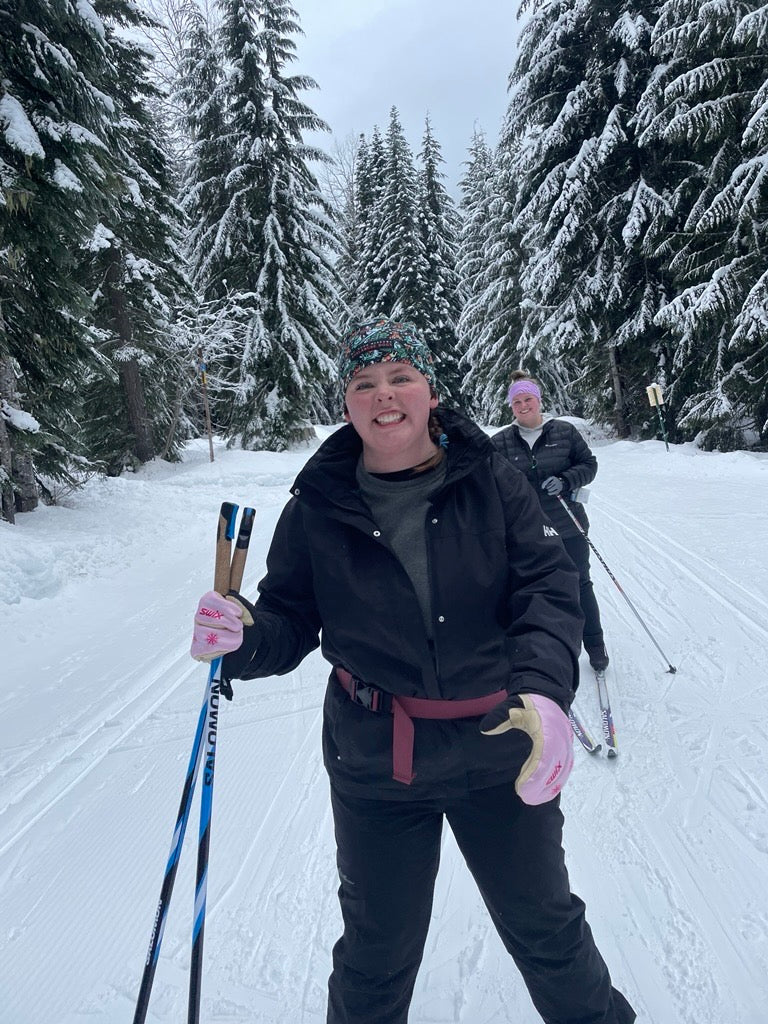
Hannah Sebring: Cross-Country Skiing Is for Everybody and Every Body
AMBASSADÖRK Hannah learned to ski more or less by accident, at a job she took before she knew what Nordic was. She now manages the Nordic Center at Mt. Hood Meadows and teaches first-timers for a living, which gives her a clearer view than most of who this sport is actually for.
With that, let's get to it.
ambassadörks: Cross-Country Skiing Is for Everybody and Every Body
My introduction to cross-country skiing came post-COVID-college, in a world where I knew I didn’t want a big-girl job just yet and I was going stir-crazy at my mom’s house in Colorado Springs. The first time I spoke to my soon-to-be boss, I asked what Nordic skiing was.
Yeah.
I would like the record to reflect that he called unexpectedly and I do prepare for interviews, I swear. But regardless, something clicked, and a week later I found myself, a choice selection of personal items, and the best road-trip cat a girl could ask on the drive from Colorado to Oregon in a highway-closing blizzard.
On my second day at the new job, my boss thought it would be a great idea to send me on a classic lesson so I could know what I was talking about with visitors. I was overdressed—prepared for cold temperatures, of course—and inches of snow coated the groom.
We came to the first hill, and Keith, my instructor, informed us that the best way to get up hills on Nordic skis was a quick jog.
I remember so vividly him saying, “You can just run up the hill to get grip,” and my internal monologue sarcastically exclaiming, “YOU can just run up the hill, dude. That is not happening for me.” (Love you, Keith).
He was going on about some guy named Klaebo and his revolutionary uphill technique. Meanwhile, I was wondering what I had gotten myself into—and if I was going to make it back to the Nordic Center.
Once I progressed in my classic skiing, I began dabbling in skate skiing. I remember feeling immense intimidation at the perceived fitness level necessary to make skating successful, and immense shame after a solo excursion resulted in me walking my skis back to the Nordic Center.
On the side of the groom, of course. I was a newbie, not a monster.
The next skate lesson I was in, the coaching was, “Whatever you do, don’t stop mid-hill.”
These instructors and their hills. Who the heck do they think I am?
It turns out I am someone who grew to love cross-country skiing.
And that’s the thing about this beautiful sport we all enjoy: It has a reputation for being one of the most aerobic activities you can do on land. It is often represented by high-level athletes—runners, cyclists, ice skaters, and other people who appear to have been born knowing how to efficiently propel themselves uphill on two skinny sticks.
Yet cross-country skiing is also one of the most accessible winter sports in terms of entry costs and equipment. It can be an incredible gateway to winter recreation, and I would be remiss to think that folks should be discouraged from trying it because of their body type, fitness level, or athletic background.
Watching Jessie Diggins settle into the pain cave and Klaebo’s viral storm up the hill at the Winter Games last season, a first-time viewer at home might never realize that while those two define the professional racing world of cross-country skiing, it is also completely fine to shuffle around on your mom’s old skis from the garage and slowly take in the quiet of the winter landscape.
Both are skiing.
During those same Winter Games, an instructor commented on how this class of athletes seemed to have filled out more than the athletes they remembered watching as a kid. To me, that is a positive thing for young and developing athletes across the nation. Seeing strong, capable athletes with a variety of body types can help young people understand that athleticism does not have to look one particular way—and that being strong does not require being skinny.
So how do we reconcile one of the most aerobic activities on land, done on the skinniest of skis, with the idea that people of all body types should feel welcome doing it?
My work at Meadows Nordic is largely centered around first-time lesson takers, and it has really solidified for me that this sport can be for everyone.

It’s amazing to watch someone who may have never seen snow before start their lesson nervous and timid, then come cruising back into the training area two hours later. Sometimes there’s enough energy left for a second wind and a tour on the trails. Sometimes two hours is plenty.
Both are victories. Both elicit fun and positivity and celebrate our bodies and their ability to move, maybe in ways we didn’t imagine.
Movement doesn’t become more worthwhile because it is faster. Your skiing doesn’t become more legitimate because it is harder.
People of all walks of life have learned how to move their bodies and enjoy nature in a new way through these lessons. They don’t all look like elite athletes. They don’t all move the same way. They don’t all have the same goals.
And they don’t have to. In fact, that’s kind of the point.
There is, of course, still room for improvement in the inclusiveness of the sport and its gear. Many combi-boot cuffs dig into the very muscles I’ve developed that should, in theory, make me a strong skier. Finding gear that fits a wider range of bodies is still a challenge. There is work to be done.
Compared to many winter sports, it is much easier to come as you are. You don’t necessarily have to invest in a helmet, goggles, bibs, huge jackets, specialized socks, and a pile of other equipment before you even give it a go (don’t get me wrong, I love my alpine time, too). In Nordic, you can show up in whatever winter layers you already own and learn.
And then there’s the funny part: some of the “fittest”-looking students come back with more complaints of soreness than one might assume.
It’s a nice reminder that there is no single mold for what fitness—and fit bodies—look like.
A person can look like a professional athlete and struggle through their first lesson. A person may never have exercised consistently and find themselves gliding across the snow with a grin on their face. Someone can spend two hours learning to stop, turn, and climb a hill. Someone else can spend those same two hours chasing a personal best.
There is room for all of it.
Regardless of whether you mastered the glide, hit your VO2 max (still don’t quite know what that means), shuffled along at a mellow pace, or stopped a zillion times, you went skiing.
And maybe that’s the part we forget when we talk about fitness.
Movement doesn’t become more worthwhile because it is faster. Your skiing doesn’t become more legitimate because it is harder. You don’t have to earn your place on the trail by being thin, fast, strong, coordinated, or particularly good at getting up hills—I know I still struggle.
You just have to show up.
Cross-country skiing can be competitive. It can be technical. It can be brutally aerobic. It can also be quiet, silly, social, meditative, beautiful, and completely recreational.
It welcomes the leisure skier, the fastest racer, entire families, first-timers, lifelong athletes, and people with disabilities, both physical and intellectual. It welcomes people who want to chase a personal best and people who just want to shuffle through the trees.
It is a place for everyone.
And skinny skis are for everyone.
Authors Note: I grew up in Colorful Colorado, though I now lie my glitter-clad head to sleep in Hood River, OR, where I manage the Nordic Center at Mt. Hood Meadows with the emotional support of my floofy cat Islay. I learned to XC on Mt. Hood, where I also now downhill, tele, and occasionally embarrass myself on a snowboard. I hold a PSIA Level 1 in Cross Country and Alpine and want to grow my glide even more! Hannah can be found over on the grid @hannah.dares
the closer: What We're Thinking About.
That Hannah has watched more people clip in for the very first time than most of us ever will, and came back with the least gatekeepy take in the sport. Show up in whatever is already in your closet. The track does not check. Takk, Hannah.
Share:
Cole Mirek: How Creating Content Changed My Perspective on the Sport of Nordic Skiing
Alex Taylor: Good Pain, Bad Pain